
Budget Laser Cutters: Are Cheap Machines Actually Worth It? (UK, 2026)
By Jake Osman, laser engineer — Focused Laser Systems
A cheap laser cutter looks like a bargain right up until the moment it isn’t — when the tube drifts mid-job, the “support” inbox goes quiet, or you realise the headline price didn’t include the extraction, chiller and enclosure the machine actually needs to run safely. We repair and replace these machines for a living, so this is an honest look at what budget laser cutters get right, where they catch people out, and when one genuinely makes sense.

Do cheap laser cutters actually work?
Yes — with caveats. For light hobby engraving on wood, leather or card, an entry-level machine will get you started and let you learn. Where budget machines struggle is cutting (rather than engraving), consistency over a long run, and longevity. A low-powered diode unit will labour on anything thicker than a few millimetres, and a cheap CO2 tube tends to lose power and drift as it ages, so the setting that cut cleanly last week doesn’t this week. If your plan is occasional, low-stakes engraving, a cheap machine can work. If you’re cutting acrylic, running batches, or relying on it for income, that’s where the cracks show.
The common problems with cheap laser cutters
The issues are predictable, because we see the same ones come back to the bench:
Unstable tube and power — output wanders, so cut depth and engraving tone vary between jobs, and the tube’s usable life is short.
Poor optics and motion — cheap mirrors and lenses scatter the beam; loose motion systems cause misalignment on detailed work.
Cooling and extraction as afterthoughts — underspec cooling shortens tube life; weak fume extraction is a quality and a health problem.
Cloned or limited software — generic control software makes clean imports and repeatable results harder.
Build quality and reliability — thin frames and budget electronics mean more breakdowns, and downtime is lost work.
No UK support or warranty — when a marketplace import fails, there’s often no UK help and no meaningful warranty.
Common safety hazards — such as open frames, missing interlocks, and inadequate ventilation—significantly increase the risk of eye injuries, fire, and toxic fume exposure.
What to check before you buy a budget machine
If you’re set on a budget machine, at least pressure-test it on these: Is it a fully enclosed (Class 1) design, or open-frame? Does it run LightBurn, or only cloned software? Is there UK-based support and a real warranty? What extraction and cooling does it need, and are they included? And can you get spare parts in the UK? If the answers are vague, treat the price as a deposit on future frustration.
How much do budget laser cutters cost — and the hidden costs?
The sticker price is only part of it. To run a laser safely and well, you also need fume extraction or filtration, a water chiller (for CO2), air assist, a proper enclosure, and safety eyewear for open-frame machines — and on a budget unit those often aren’t included. It’s how a “cheap” machine quietly becomes a much bigger spend, and why a slightly higher upfront cost can work out cheaper over the life of the machine. For a full picture of where the money goes, see our breakdown of how much a CO2 laser really costs in the UK.
Budget vs quality: what’s worth the investment
Two machines can look identical on paper and perform completely differently. Here’s how a quality system compares with a typical cheap one:
| Aspect | ✅ Pros of Quality Laser Cutters (e.g., Focused Laser Systems) | ⚠️ Cons of Cheap Laser Cutters |
|---|---|---|
| 🔧 Laser Performance | ✅ Stable, high-powered laser tubes (e.g., Reci) ensure consistent, clean cuts | ⚠️ Weak, unstable lasers cause uneven results and reduced output quality |
| 🔍 Optics & Beam Quality | ✅ Premium optics provide crisp, sharp details | ⚠️ Low-grade mirrors distort the beam, causing blurry edges |
| 🎯 Motion Control | ✅ Precision-engineered motion systems deliver smooth and accurate engraving | ⚠️ Jerky, inaccurate motion leads to misaligned designs |
| 💨 Cooling & Fume Extraction | ✅ Reliable cooling and efficient fume extraction improve performance and safety | ⚠️ Overheating and poor ventilation can damage components and harm users |
| 🖥️ Software & Integration | ✅ Intuitive software with training and expert support | ⚠️ Confusing, unoptimised software hinders usability and results |
| ⚙️ Build Quality & Reliability | ✅ Durable components reduce breakdowns and extend lifespan | ⚠️ Frequent malfunctions and low build quality create workflow disruptions |
| 📐 Material Compatibility | ✅ Cuts and engraves a wide variety of materials, including thick and dense options | ⚠️ Limited to thin or soft materials; slower processing times |
| 🛡️ Safety Features | ✅ Class 1 certified with interlocks, e-stop, and safe enclosure | ⚠️ Lacks key safety systems; higher risk of injury or fire |
| 📞 Support & Warranty | ✅ 2-year warranty plus lifetime tech support | ⚠️ Minimal or no support; often no warranty coverage |
| 💼 Business Use | ✅ Dependable for professional production, client work, and scaling | ⚠️ Inconsistent output harms business reputation and sales |
| 💸 Cost Effectiveness | ✅ Higher upfront cost, but better value over time. Finance options are available. | ⚠️ Cheap initially, but costly due to frequent repairs and limitations |
| ♻️ Upgrade Options | ✅ Tailored to your needs. | ⚠️ Limited or no upgrade potential; one-size-fits-all machines |
A quick note on materials, since it trips people up: a CO2 laser cuts non-metals (wood, acrylic, leather, card) and can mark some coated or anodised metals with a marking spray, but it won’t cut bare metal. For anything beyond light hobby use, we’d point you at a properly built machine; see our Vision CO2 laser cutters. Every claim in that table pairs with something concrete: the tube brand, the safety class, the warranty, which is exactly what a cheap spec sheet can’t back up.
When a cheap laser cutter makes sense (and when it doesn’t)
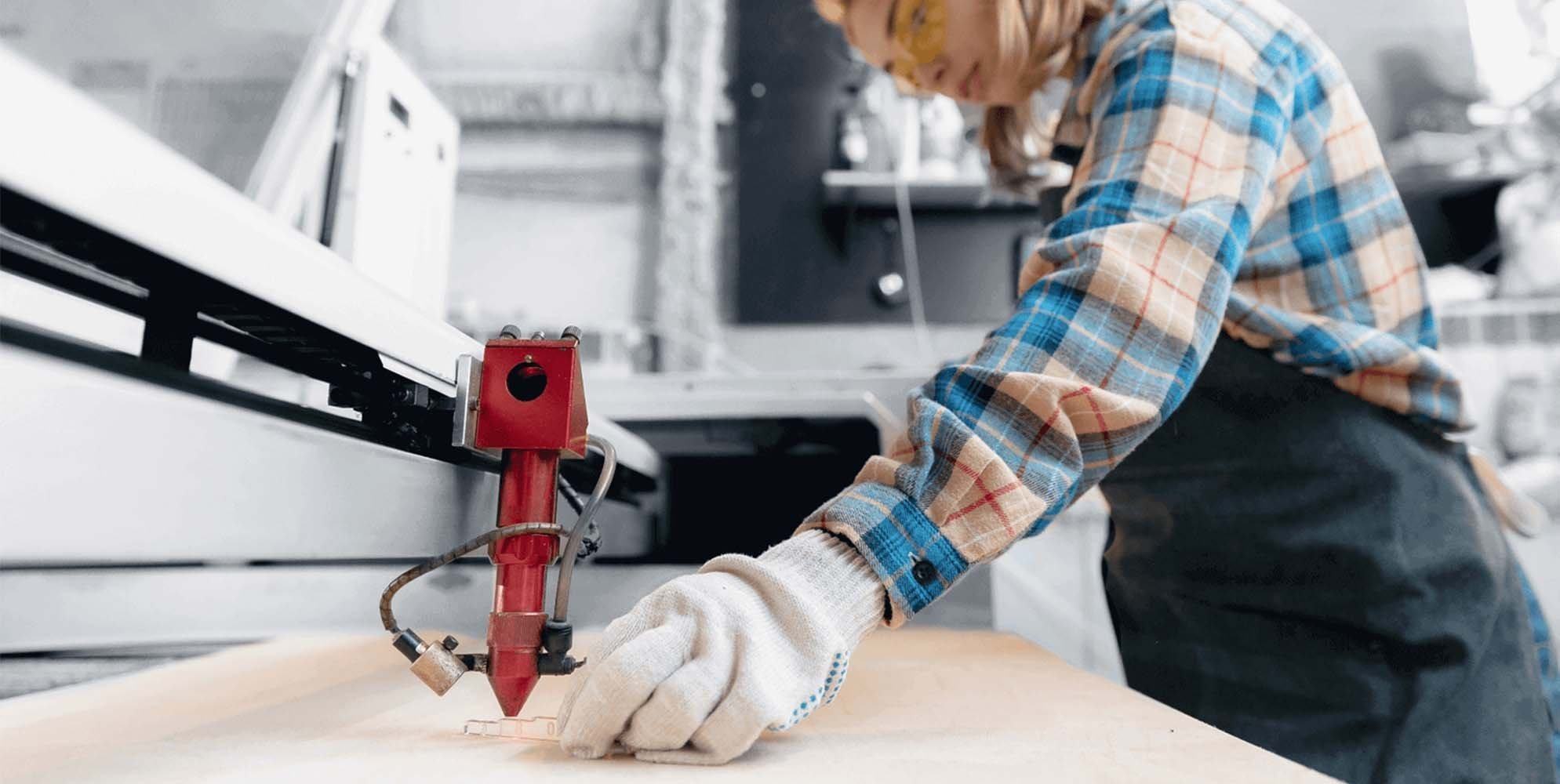
We’re not going to tell you no one should ever buy budget — that wouldn’t be honest. A cheap machine can be the right call if you’re a hobbyist on a tight budget, doing light engraving, with realistic expectations and a safe, ventilated space to work in.
Opting for a cheap laser machine is a false economy when uptime is critical. For businesses, a dead machine means missed orders and lost revenue. In education, safety and compliance are absolutely non-negotiable. UK schools must adhere to BS 4163:2021+A1:2022 (the Health and Safety Code of Practice for Design and Technology) alongside CLEAPSS guidance. This requires classroom machines to operate as fully enclosed Class 1 laser products that are securely interlocked and safe to supervise. (Read more in our comprehensive guide to laser cutters for schools). Ultimately, if downtime costs you money or compromises safety, it pays to buy right and buy once.
A safer middle ground: refurbished CO2 lasers
Most guides skip the sweet spot between a "cheap import" and a "brand new" machine: a professionally refurbished CO2 laser. Our engineers strip down, recondition, and rigorously test each machine, replacing any worn parts to ensure optimal performance. You get a commercial-grade build and the same lifetime UK support as a new model, but at a fraction of the cost. Backed by a 1-year warranty and starting from just £2,000 with flexible finance options, it is the smart way to upgrade your workspace. It’s the reassurance without the risk — have a look at our refurbished CO2 laser cutters.
Budget laser cutters: FAQ
Do cheap laser cutters actually work?
For light hobby engraving, yes. They struggle with cutting thickness, consistent output, and lasting the distance.
Are cheap laser cutters worth it?
It depends on the job. Fine for low-stakes hobby use; a false economy for business or school work where downtime, support and safety matter.
What are the main disadvantages of a budget laser cutter?
An unstable tube, poor optics and motion, little or no UK support or warranty, safety gaps, and hidden running costs.
Can you get a decent laser cutter under £1,000?
You can buy a machine at that price, but budget for the extraction, chiller and enclosure it needs on top — and consider a refurbished machine instead.
Are cheap laser cutters safe?
Only if they’re enclosed (Class 1) with proper extraction. Many budget open-frame machines aren’t — and you should never cut PVC on any laser (it releases chlorine gas).
Can I use a budget laser cutter for a business or school?
For schools, you need a properly enclosed laser cutting machine that meets BS 4163:2021+A1:2022 expectations. For a business, weigh the downtime and support risk carefully.
The honest verdict
A cheap laser cutter isn’t always the wrong choice — but it’s the wrong choice far more often than the price tag suggests, especially once safety and support are on the line. Work out what you actually need the machine to do, add up the real cost of running it safely, and buy once rather than twice. If you want a straight answer for your situation, talk to our engineers — no ticket queue, no hard sell.
