
How to Choose the Right Focal Lens for Your CO₂ Laser
Have you ever wondered why your photo engravings look a bit soft? Or when you laser-cut thick plywood, it comes out at a frustrating angle? It's a common issue, and the culprit is often one of the most important—and most misunderstood—parts in your entire machine: the focal lens.
This small, circular piece of ZnSe (Zinc Selenide, for the curious) is the "make or break" part of your laser's process. It’s the last thing the beam touches, and it's responsible for turning that big, raw beam into a tiny, powerful point of energy.
The good news? We've sat down with our engineering team to demystify laser optics for you. In this post, we'll break down what focal length really means, explore the most common lenses (from 1.5" to 4"), and give you a simple cheat sheet to pick the perfect lens for any job. By the end, you'll be a focal-length pro.
What is a CO₂ Laser Focus Lens?
Conceptually, a laser cutting machine's focal lens functions similarly to a magnifying glass. Just as a glass lens concentrates sunlight into a singular point of intense heat, the laser lens converges the CO₂ beam into a precise, high-density focal point to maximise cutting power.
That "just right distance" is what we call Focal Length (FL).
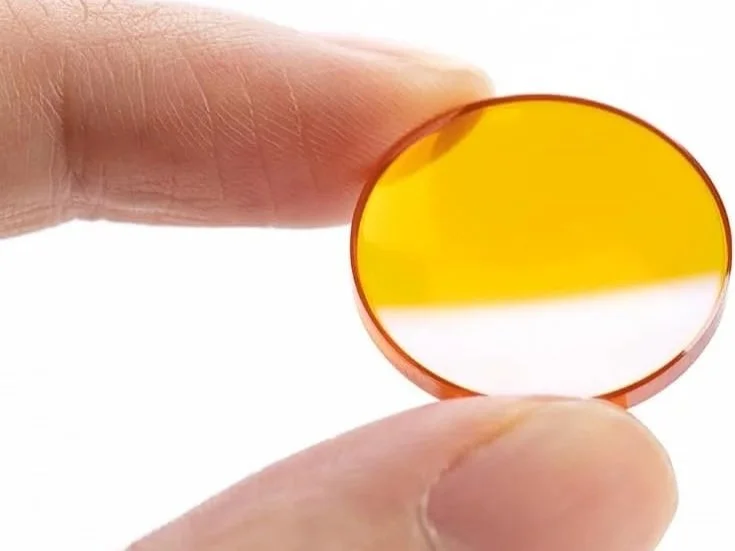
It's the physical distance from the lens down to that perfectly focused, 'white-hot' focal point. A short focal length (e.g., 1.5 inches) means the lens is designed to work very close to the material. A long focal length (e.g., 4 inches) means it works at a distance from the material.
The "Big Trade-Off": Spot Size vs. Depth of Focus
Every lens has a "Big Trade-Off" between its Spot Size and its Depth of Focus (DOF).
Imagine the focused laser beam is shaped like an hourglass. The Spot Size is the thinnest part of the hourglass, and the Depth of Focus is how tall that thin part is before the beam gets too wide again.
Short FL Lenses (e.g., 1.5" or 2"): These create a very steep, short hourglass.
Pro: A tiny, tiny spot size. Perfect for insane detail.
Con: A shallow Depth of Focus. The 'sweet spot' is very small, so if your material isn't perfectly flat, you'll go out of focus fast.
Long FL Lenses (e.g., 4"): These create a very tall, skinny hourglass.
Pro: A massive Depth of Focus. The 'sweet spot' is huge, making it great for uneven surfaces.
Con: A larger spot size. All that power is spread out a bit more, so you lose fine-detail capability.
What is the Best CO₂ Laser Lens for Engraving or Cutting?
So, let's pull it all together. As our engineers always say, there is no single 'best' lens—only the right lens for the job. To make it easy, here is our quick-reference guide.
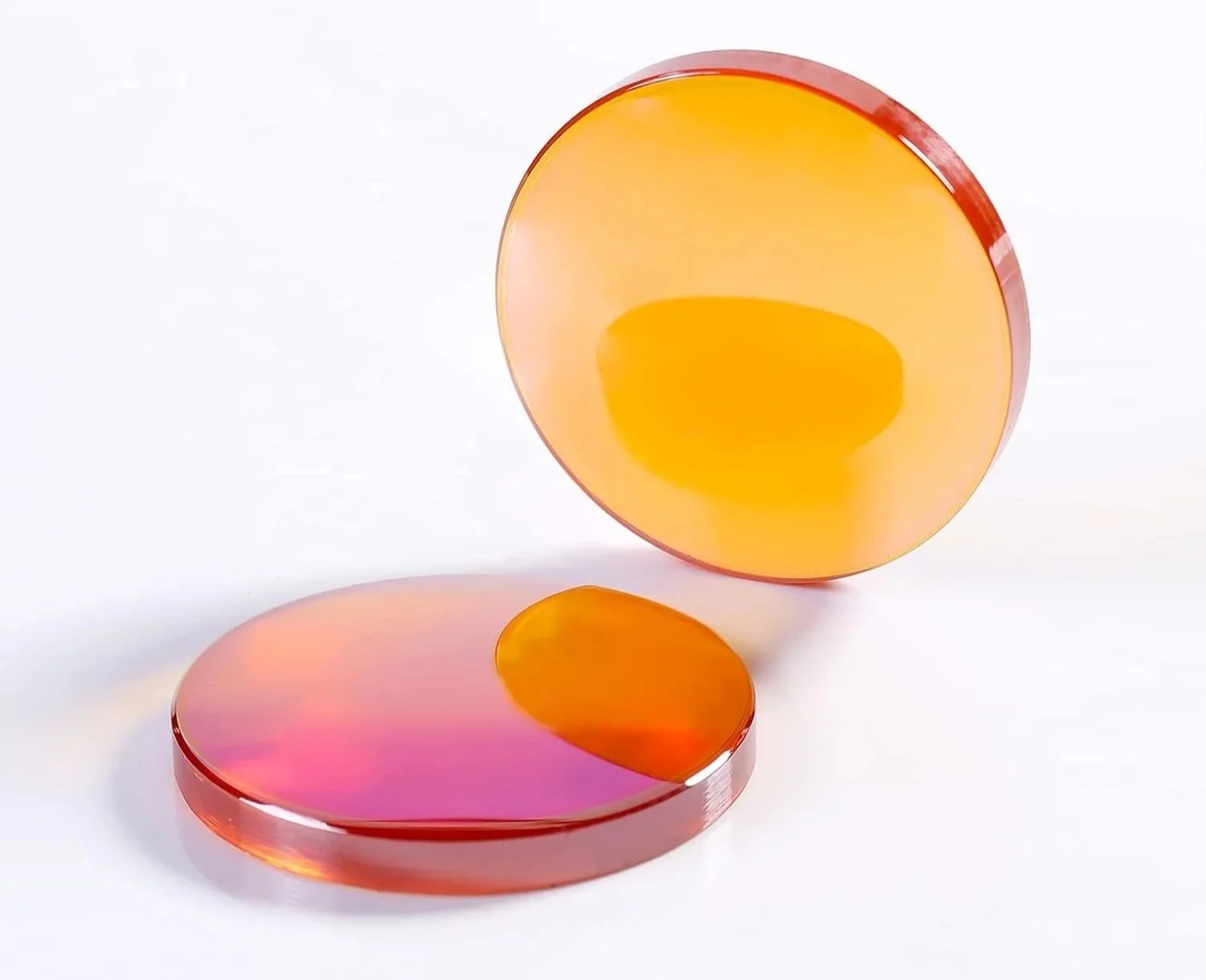
General All-Purpose Use (2.5" Focal Lens)
AKA: The Stock Lens (this is what most laser machines ship with)
Spot Size: Medium
Depth of Focus: Medium
Best For: This is the "jack-of-all-trades." It's the lens you'll use 90% of the time. It produces crisp, high-quality engraving results and can cut common materials (such as 3mm-6mm acrylic and plywood) beautifully and efficiently.
The Catch: It’s the best compromise. It's not the best at engraving (the 1.5" is better) and not the best at thick cutting (the 4" is better).
Best Focal Lens for High-Detail Engraving (1.5" or 2" Focal Lens)
Spot Size: Smallest
Depth of Focus: Shallowest
Best For: This lens is the specialist for high-fidelity work. Use it for high-resolution photo engraving, super-tiny text (like on a pen), and cutting fragile materials (like paper or fabric) with a hair-thin cut line (kerf).
The Catch: Because that DOF is so shallow, your material must be perfectly flat, and your focus has to be spot-on, or your results will get blurry.
Best Focal Lens for Cutting Thick Materials (10mm+) (4" Focal Lens)
Spot Size: Largest
Depth of Focus: Deepest
Best For: This is your heavy artillery, and it's best for two key jobs:
Thick Materials: Cutting 10mm, 12mm, or 15mm+ wood. That long DOF 'hourglass' keeps the beam focused throughout the material, which gives you a straighter, 90-degree cut edge instead of the 'V' shape you get when a short lens goes out of focus at the bottom.
Uneven Materials: Cutting on a warped piece of plywood or a slightly curved object. The deep DOF means the beam stays in focus even if the material's height changes somewhat.
The Catch: Don't try to engrave photos with this. The larger spot size means your engravings will look 'chunky' and all the fine details will be lost.
Quick Tips from our Laser Engineers
Before you run off to buy a new lens, here are a few critical, rapid-fire tips from our engineering team that you must know.
Lens Diameter (18mm, 20mm, etc.): This is simple: it just needs to fit the lens tube on your machine. Diameter does not affect performance; only compatibility does. Check your machine's specs!
Plano-Convex vs. Meniscus: You'll see these two types. A Plano-Convex lens is the standard (flat on one side, curved on the other) and offers excellent performance. A Meniscus lens is a 'premium' option (curved differently on both sides) that can provide a slightly smaller spot size for a given focal length. It's a nice upgrade, but not essential for most users.
CRITICAL: Lens Orientation: This is the #1 mistake we see new users make. Your lens MUST be installed correctly, or it won't focus at all. For the standard Plano-Convex lens, the rule is simple: 'CURVED SIDE UP' (the convex 'bump' should face the sky, and the flat side should face your material). Get this wrong, and you'll spend hours troubleshooting what you think is a broken laser!
Get Free, Expert Advice from the UK's CO₂ Laser Specialists
Not sure if you need a 2.5" lens for all-around use or a 4" for thick materials? Let's figure it out together.
At Focused Laser Systems, our in-house team is here to help you get the right part, the first time. Contact us today with your machine specs and what you want to achieve, and we'll personally recommend the perfect lens for your setup.
Contact our Devon Showroom for tailored advice:
📞 Call us: 01271 626406
💬 WhatsApp us: Message on WhatsApp
📧 Email us: sales@focusedlasersystems.com
